“To see an empowered Parkari community; literate, healthy, self-reliant, socially integrated, and free from socioeconomic oppression”.
PCDP mainly focuses on women and children. It has a strong emphasis on community-owned schools which develop mother tongue literacy and numeracy materials to enable children to transfer their learnt skills into provincial, national and international languages.
PCDP realizes its vision through implementation of field based programmes in cooperation with Parkari village communities.
HISTORY
The Parkari Community Development Programme (PCDP) was founded in 1996 by a young Parkari man Mr. Poonam Paschal, in collaboration with other supporting people. The development of Parkari as a written language with a standard orthography began in 1983 when the Parkari Language Committee was formed to decide how Parkari should be written and what kinds of literature should be produced. Mr. Sajjan Parmar, a Parkari man was chairman of this committee and he also produced a hand written magazine in Parkari called “Prem Parchar”.
In 1985, the first Parkari books were produced by Poonam and other Parkaris. By 1995 there was already a lot of reading material produced about health, education and general knowledge, but very few people were able to read Parkari. Thus, distributing literacy materials throughout the Parkari community became a major focus. The script used for writing Parkari is based on the script used for Sindhi, the main regional language. So, if a Parkari can read Sindhi, it is easy for them to read their own language
With the literacy rate for the Parkari community being only about 2%, the production of audio cassettes based on available literacy materials began in 1996. Mr. Jokim Hamdam Goel, a Parkari man with experience in producing drama and audio recordings from his time at a local Audio Visual Centre, was hired to facilitate this. Thus, the Parkari Audio Visual Project (PAV) was started in 1996.
Later, in 1999, PAV evolved into the Parkari Community Development Programme (PCDP). In 2003, according to the regulations of the societies Act XXI of 1860, PCDP was registered as a society, number 4101. Originally the main idea was that PCDP would promote awareness amongst the Parkari community about the printed and audio materials now available in their own language. However, PCDP developed into something far wider, and began to encourage an awareness of social development throughout the Parkari community on a non-religious, non-political and non-profit basis.
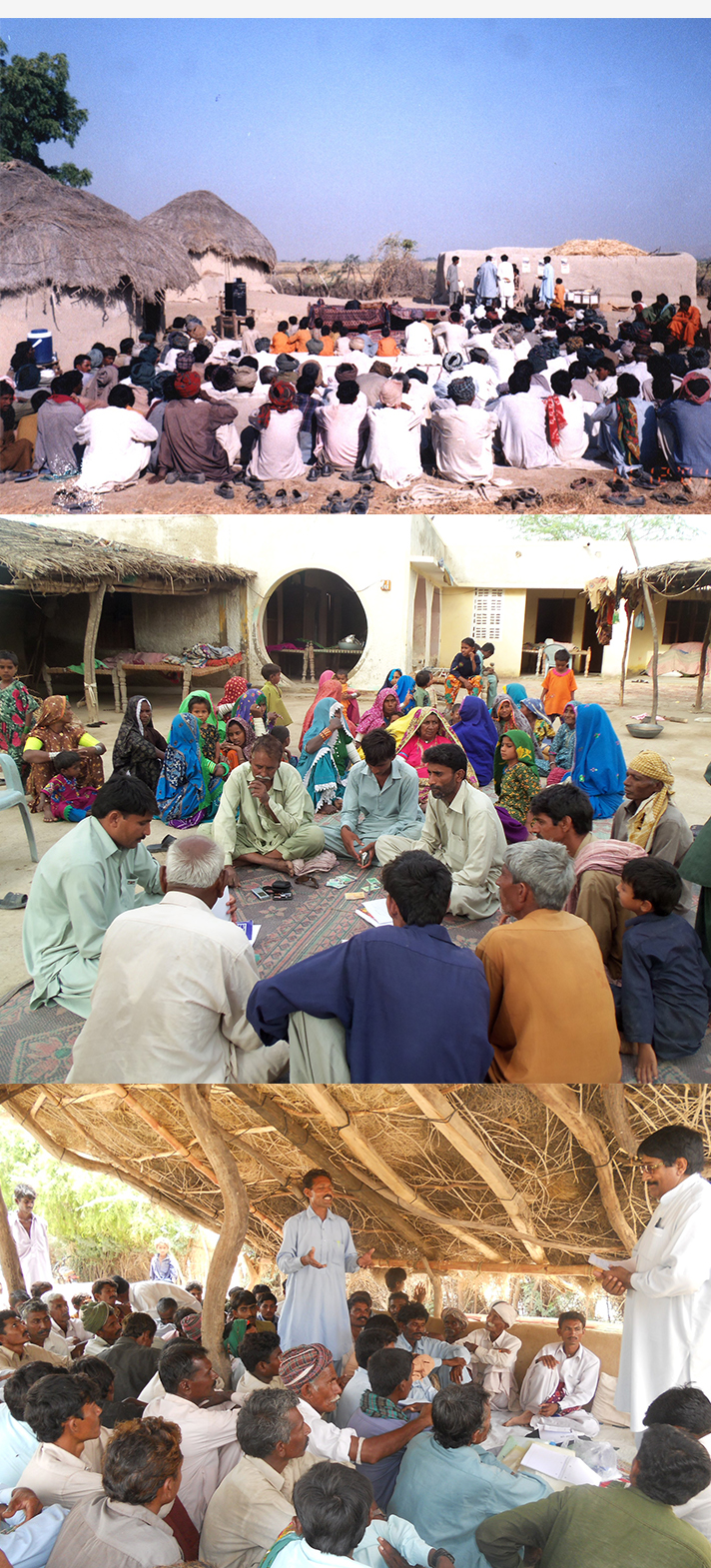
Education was the first social development initiative. Until 1999, even though there were printed and audio materials available for starting literacy classes, a lack of trained literacy personnel made this very difficult. However, there was an answer to prayer PCDP decided to work on mother-tongue based Multilingual Education (MLE) programme by establishing the Parkari literacy project (PLP). Initially, one MLE pilot project was started in a village. Then in 2000, after the 1st MLE project seemed successful, five more MLE schools were started in five additional villages located in the rural areas. At this time, Parkari MLE schools were unique in the region, with children starting their education in their own language before learning languages of wider communication. MLE made it easier for pupils to read, write and understand the curriculum. This also created a strong interest among the Parkari community as to how education can be the key to a brighter and more promising future.
Since 1999, PCDP has also worked in the field of community development among the Parkari community, one of the most under privileged and marginalized group in the Lower Sindh, and responded in many ways to the Parkari community’s numerous felt needs.
INTRODUCTION
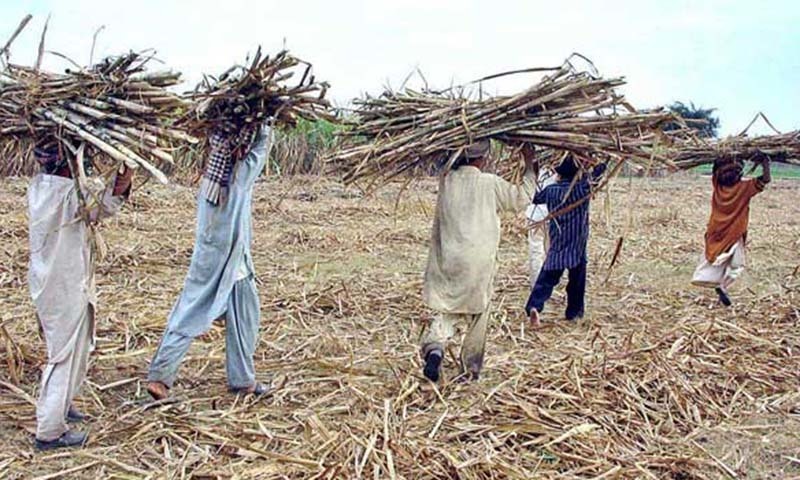
PCDP focuses on the Parkari community, which numbers up to 1.2 million, scattered throughout lower Sindh. 99% are peasant farmers, either owning land in the Thar Desert area where drought is frequent, or living as landless farm labourers in the irrigated area where they work under landlords. The community’s social status is that of a scheduled caste within the caste system. Much of the Parkari community live in rural areas and do not have access to education therefore the illiteracy rate is high. The majority of the Parkari community is engaged with agriculture as farm laborers working for non-Parkari landlords. Most Parkaris are not registered with the National Database Registration Authority (NADRA) and have not got their Computerized National Identity Card (CNIC), which is the main document identifying them as Citizens of Pakistan, as well as giving access to government facilities. Also they are not enrolled in the Voter List of Election Commission of Pakistan. Moreover, the majority of Parkari children are not registered with the local government and NADRA, which creates problems for the government for census purposes.
Few Parkaris have vocational skills. Most villages lack the basic essentials of clean drinking water and access to education and health services. Women and children are the most disadvantaged.
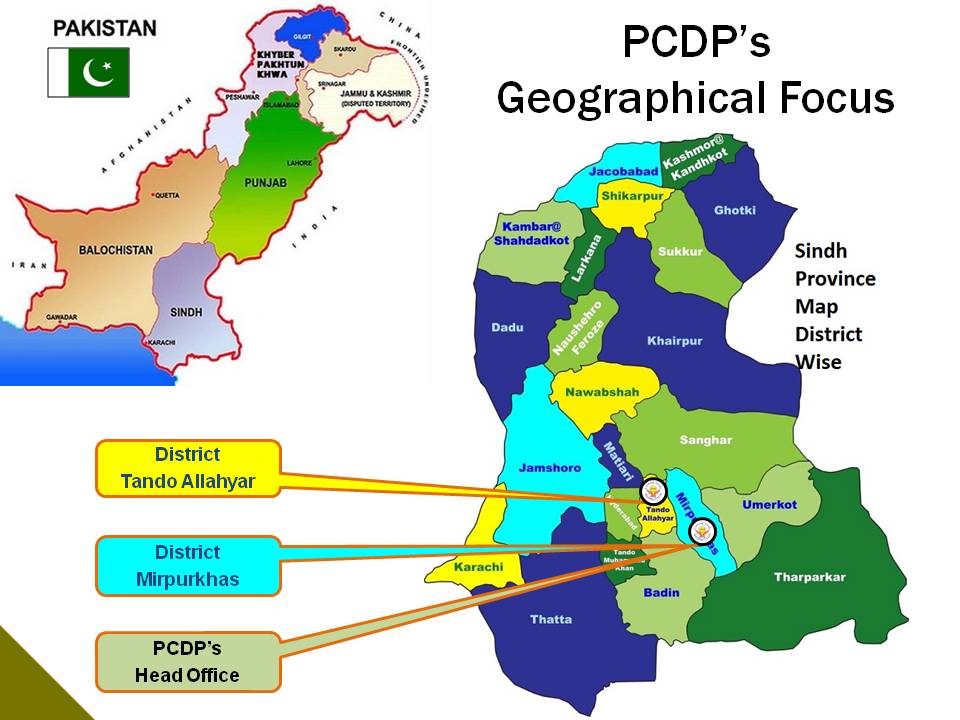
In response to these needs, PCDP as an active community based organization is working in the rural areas of 2 districts of the lower Sindh province for the benefit of all members of the Parkari community.
Legal Status of Parkari Community Development Programme (PCDP)
✅ Registered with Government of Pakistan under the Societies Act 1860.
✅ Registration Number: 4101 of 2003-2004
✅ The National Tax Number (NTN) is 4176229.
✅ Certified with Pakistan Centre for Philanthropy (PCP)
✅ Signed the MOU with Economic Affair Division (EAD)
PCDP’s Policies
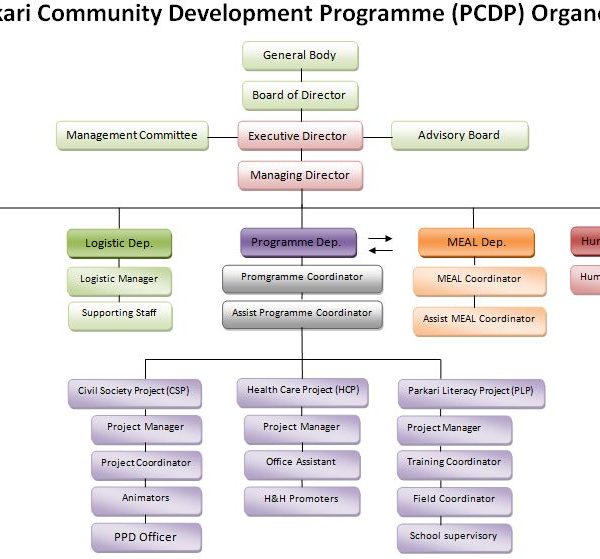
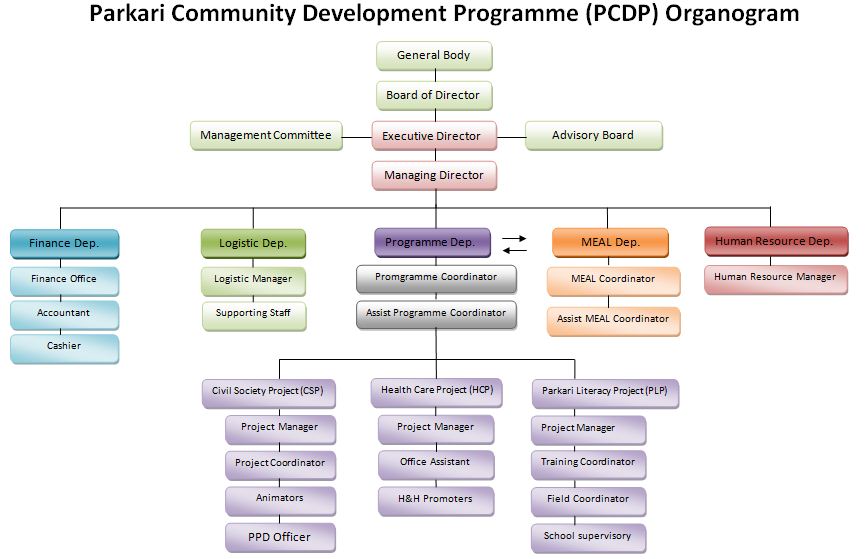
PCDP Organizational Structure
PCDP’s Board is responsible for reviewing budgets, financial reports and progress reports, and ensuring that the organization operates according to its stated objectives and procedures.
PCDP Working Areas